

به جاودانگی خوش آمدید
Correspondence between Sheikh Ishraq’s thoughts and the architecture of the Safavid period
- author: Dr. Mohammad Javad Mahdavinejad, Engineer Moein Aghaei Mehr, Engineer Hossein Raji, Mohammad Khayyat Zanjani
- pages: 22
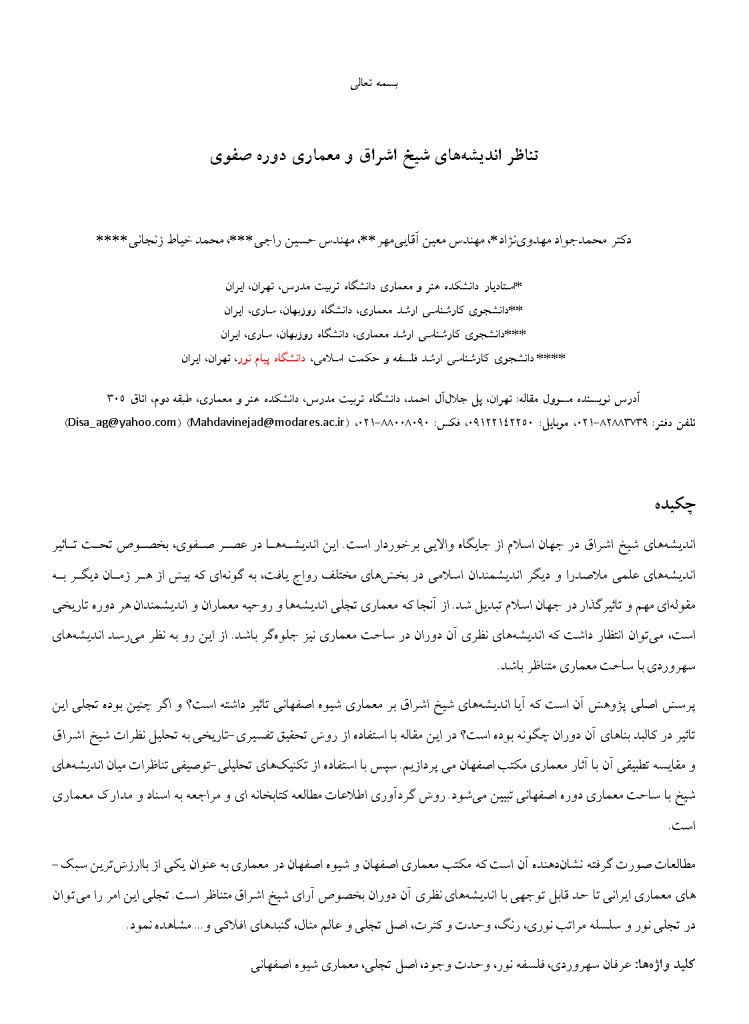
The ideas of Sheikh Ishraq have a high status in the Islamic world. These ideas became popular in various sectors during the Safavid era, especially under the influence of the scientific ideas of Mulla Sadra and other Islamic thinkers, in such a way that they became an important and influential category in the Islamic world more than ever before. Since architecture is the manifestation of the ideas and spirit of architects and thinkers of every historical period, it can be expected that the theoretical ideas of that period would also be reflected in the field of architecture. Therefore, it seems that Suhrawardi’s ideas correspond to the field of architecture. The main question of the research is whether the ideas of Sheikh Ishraq had an impact on the architecture of the Isfahan style? And if so, how was this impact manifested in the structure of the buildings of that period? In this article, using the interpretative-historical research method, we will analyze the ideas of Sheikh Ishraq and compare them comparatively with the architectural works of the Isfahan school. Then, using analytical-descriptive techniques, the correspondences between the Sheikh’s ideas and the architectural landscape of the Isfahan period are explained. The method of collecting information is library study and reference to architectural documents.
The studies conducted show that the Isfahan architectural school and the Isfahan style in architecture, as one of the most valuable Iranian architectural styles, correspond to a significant extent with the theoretical ideas of that period, especially the ideas of Sheikh Ishraq. The manifestation of this can be seen in the manifestation of light and the hierarchy of light, color, unity and plurality, the principle of manifestation and the world of examples, celestial domes, etc.